
Beyond Consensus
Decoding the Symphony of Science with Research Consensus Explorer
Science is not a ledger of immutable facts. It is a living, breathing ecosystem — a turbulent ocean of hypotheses, incentives, instruments, and human choices. Papers are like plankton: abundant, individually small, but collectively able to shape the currents. Consensus is not a single point on that ocean; it is a pattern of eddies, flows, and dead zones that reveal where knowledge is robust, where it is precarious, and where new life can bloom.
Research Consensus Explorer (RCE) was conceived as an instrument to listen to these currents — to translate distributional signals, temporal rhythms, and structural topologies into actionable insight. This essay maps RCE’s philosophy, mechanisms, workflows, and future arc: how to move from passive reading to active cartography, from citation counts to emergent dynamics.
Hook — Science as an Ecosystem, Not a Scorecard
Imagine an estuary: freshwater meets sea; currents collide; nutrients concentrate in unpredictable pockets. Some species flourish briefly and then vanish. Similarly, research fields pulse — sudden funding-driven blooms, slow cultural shifts, and quiet abandonments where entire sub-disciplines atrophy. Traditional reviews flatten that motion into static statements: “X is true” or “Y is contested.” RCE aims to recover the motion — the hidden harmonics and dissonances — by combining stance distributions, temporal analytics, and network topology into a single interpretive lens.
The result: consensus seen not as a binary endpoint but as a fractal. Across scales, patterns repeat: micro-consensus within labs, meso-consensus across subfields, macro-consensus across disciplines. Fractal consensus reveals how local methodological choices amplify into global belief — and how local reversals can cascade.
Core Signals RCE Amplifies
RCE converts raw bibliometrics and textual stances into interpretable signals:
- Veiled Vulnerabilities: Clusters where methodological uniformity or narrow data sources create structural brittleness.
- Quiet Abandonments: Research strands that show early activity then steady attrition, often visible only after layering temporal filters.
- Bias Influences: Systemic skew from funding sources or dominant labs; visible when stance distributions co-vary with metadata.
- Innovation Zones: Regions of high novelty density where methodological divergence and cross-disciplinary citations coexist.
- Reversal Forecasts: Early-warning patterns: small but persistent stance divergences in peripheral nodes.
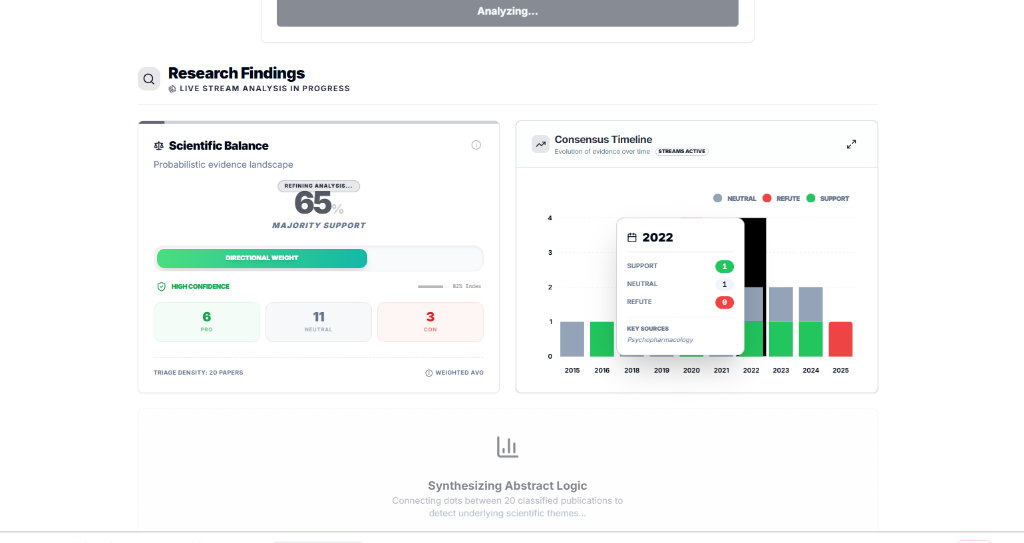
RCE Dashboard: Visualizing Scientific Balance (65% Majority Support) and Consensus Timelines.
Expand for Architectural Logic
Internally, RCE operates as a layered system:
- Ingestion and Canonicalization: Harvesting bibliographic metadata, funding acknowledgements, and full text where available. Canonicalizing entities (authors, grants) ensures high-fidelity network construction.
- Stance Extraction: Using transformer-based supervised classifiers (fine-tuned on citation intent datasets like ScisummNet), RCE identifies polarities—Supporting, Neutral, or Refuting—relative to a specific query.
- Multiplex Graphs: Nodes are connected via multiple layers: citations, co-authorship, shared funding, and methodological similarity. This allows for multi-dimensional centrality analysis.
- Temporal Flow Modeling: By treating consensus as a vector field, RCE computes "local velocities" (the direction of consensus drift) and "curvature" (the rate of potential reversal), allowing it to predict shocks before they appear in mainstream reviews.
- Anomaly Detection: Unsupervised precursors flag micro-dissonances—small peripheral clusters whose stance sign differs from the local mainstream but show rising velocity.
The Landscape in 2026: What’s Shifted
The last few years have moved literature analysis from keyword search to thematic synthesis. Platforms like Consensus and Iris.ai have matured into enterprise-grade pipelines, while agentic platforms like Cypris emphasize the integration of patents and market signals. Notebook-style systems like NotebookLM have become interactive “thinking partners.”
RCE aligns with these trends but pushes further: not merely extracting themes, but modeling the dynamics of those themes across time and topology to predict where consensus will harden or fracture.
Practical Workflows: From Theory to Cartography
For the PhD Student — Finding Dissertation Space
Query a topic, generate a stance heatmap, and layer funding metadata to exclude grant-driven spikes. Identify loci of stagnation: moderate volume with low method diversity. These are candidate "stagnation signals" indicating under-explored, publishable niches.
For the Venture Capitalist — Technology Viability
Compute a "reversal risk score": high when supporting claims are concentrated in small cliques and rely on proprietary datasets. Layer market adoption signals and Cypris-style patent metrics to estimate runway and tech-readiness.
For Policymakers — Mitigating Bias
Query literature and extract stance clusters by geography. Use "what-if" simulations to exclude industry-funded studies and recompute consensus contours. If they shift materially, flag for caution. Reflect structured uncertainty, not rhetorical certainty.
Ethical Guardrails and Epistemic Humility
Tools that reveal consensus dynamics must be wielded with humility. RCE’s outputs are probabilistic syntheses; they cannot substitute for domain-expert judgment. Every result is accompanied by provenance (Input Query -> Funder Data -> Model Version) to ensure transparency. Flagged vulnerabilities are prompts for targeted replication, not automated retractions.
The Call to Action: Become a Cartographer
RCE reframes the researcher’s role. Instead of clerks cataloguing statements, users become cartographers mapping the terrain of ignorance and opportunity. Listening to the “unwritten symphonies” — the pauses, the crescendos, the minor chords — is an act of epistemic stewardship.
Run the map on your next controversial claim. Listen to the silences. Chart the flows.